
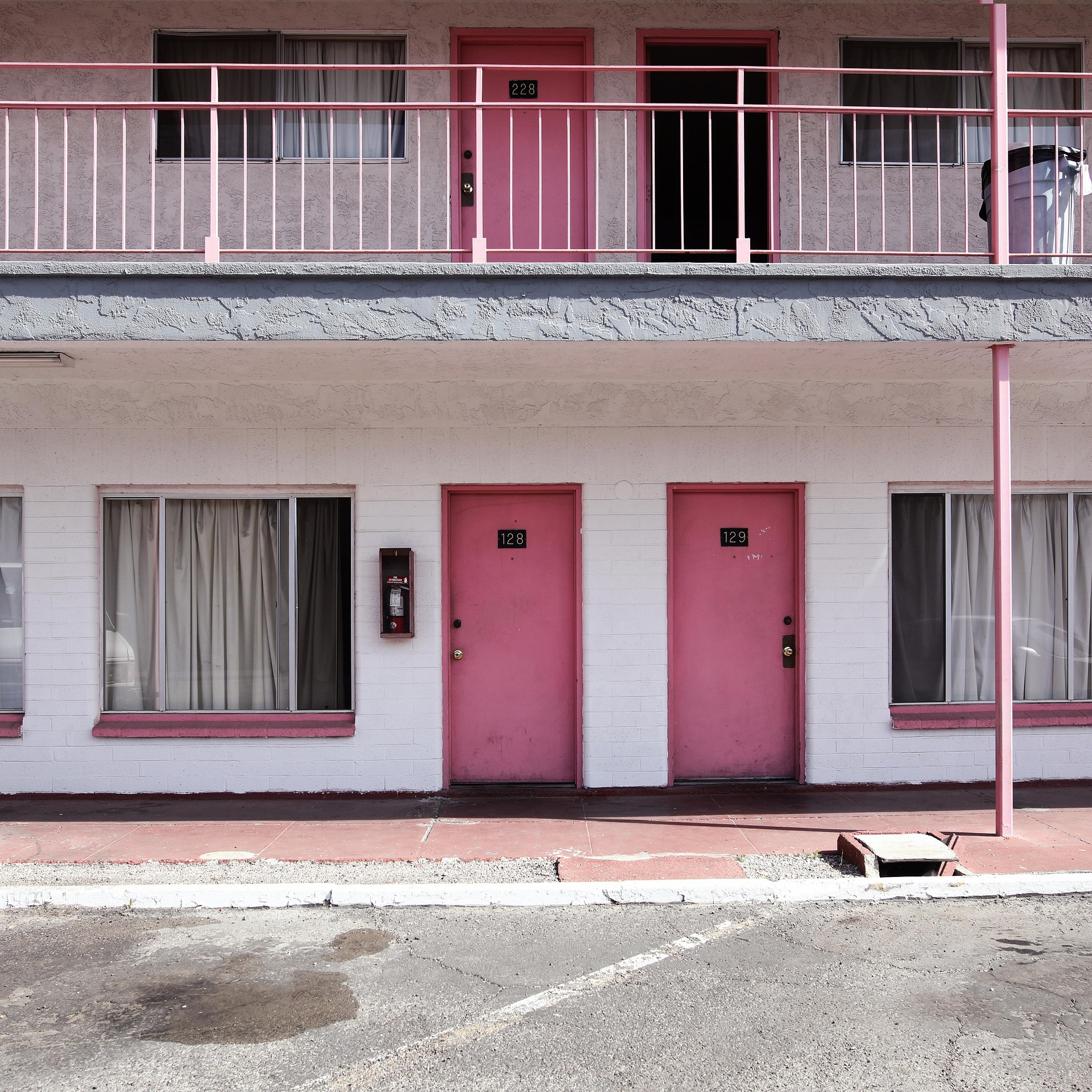
The roadside motel was once the most modern way to see America. Then the successful ones changed their names, and the word “motel” was left with whatever stayed behind.
You know the building. A long, low row of doors facing a parking lot, a sign with a couple of dead letters, a pool that’s either drained or worryingly green. You’ve driven past it a hundred times, and some part of your brain has quietly filed it under crime scene. That reaction is so automatic that it feels like common sense. But the motel was once the hottest idea in American travel, and the story of how it lost its reputation turns out to be less about motels getting worse than about where the good ones went.
My working hypothesis going in: motels didn’t simply decline. The successful ones evolved into something we stopped calling a motel, and the word was left holding everything that didn’t make the jump. That turns out to be largely true, but with a twist. The sleazy reputation wasn’t the result of that decline. It was there almost from the beginning.
The scandal came first
The word itself dates to December 1925, when the Milestone Mo-Tel opened in San Luis Obispo, California, halfway between Los Angeles and San Francisco, for $1.25 a night. The architect, Arthur Heineman, reportedly shortened “motor hotel” because the full name wouldn’t fit on the roof sign. He planned a chain of 18 along the West Coast. He built one, and lost it to foreclosure.
His invention spread anyway, because it solved a real problem. Downtown hotels were built around train stations, with lobbies, bellhops and nowhere convenient to put a car. Roadside tourist camps, cabin courts and motor courts let a family pull up, pay and park outside the door. In the early 1930s, writers celebrated them as an authentic American invention. A 1933 Harper’s article estimated that some 30,000 tourist camps had sprung up along the highways in only a few years.
The celebration didn’t last. By 1938, a pulp magazine called Crime Detective was running a lurid exposé of camps as the base of a “migratory underworld.” In February 1940, FBI Director J. Edgar Hoover lent the idea his considerable authority in an American Magazine piece titled “Camps of Crime,” calling tourist camps “a new home of crime in America”. Hoover claimed that most of the roughly 35,000 camps threatened their communities and that only “hundreds” were run honestly, and he tied them to roadhouses he described as camouflaged brothels.
Roadside historian Lyell Henry, who traced this campaign for the Society for Commercial Archeology, concludes that the charges fit some camps but went much too far as a description of the industry. Even Hoover’s denominator was shaky: Census Bureau counts found 9,848 camps in 1935 and 13,521 in 1939, far fewer than his 35,000. Henry also points to a motive beyond public safety. Hotel trade associations, losing customers to the cheap upstarts by the highway, helped darken the camps’ image throughout the 1930s.
So the “no-tell motel” isn’t a late-20th-century invention. It’s roughly as old as the motel. What changed later was who got stuck with it.
The great sorting
After World War II, the stigma faded fast, because the business got too big and too normal to scandalize. By 1947, about 22,000 motor courts were operating, and a typical motel cost around $3,000 per room to build, compared with $12,000 for a city hotel. In 1962 alone, according to Fortune, roughly 2,000 motels were built, against about 80 hotels. The industry peaked at about 61,000 motels in 1964, according to Mark Okrant’s history No Vacancy. Henry finds the “motel menace” campaign dying out by the mid-1960s, as motels became ordinary and corporate chains brought respectability.
That respectability came with a price. In 1952, Kemmons Wilson, a Memphis builder irritated by the inconsistent motor courts he’d endured on a family road trip, opened the first Holiday Inn. It was called “Holiday Inn Hotel Courts”, and Wilson later said all he ever wanted was to bring standardization to the industry so people would know exactly what to expect. Travelers loved it. According to The Motel in America, the standard academic history, the share of motels affiliated with a chain rose from about 2% in 1962 to 64% in 1987.
Here’s where the evidence starts to support the hypothesis. As chains grew, they built bigger, and by the late 1950s many were putting up mid-rise buildings with interior corridors and elevators. The University of Vermont’s guide to roadside architecture notes that the word “motel” itself gradually fell out of favor, replaced by “highway hotel” or simply “hotel.” The industry’s own signage tells the same story. Best Western began in 1946 as Best Western Motels, a referral network of independent roadside operators. In 1974, according to the company’s timeline, it eliminated the word “motel” from its name. And in 2001, the industry’s main lobbying group, the American Hotel & Motel Association, dropped “motel” too, becoming the American Hotel & Lodging Association. As one CoStar writer put it, owners seemed to treat the motel label as a drag on rates, occupancy and clientele.
The careful version of the finding is this. Some mom-and-pop motels did make the jump, by joining a referral network like Best Western or signing a franchise agreement. Many chain rooms, though, were simply new construction. Either way, the motel as a business model, a car-friendly, affordable, standardized room by the road, didn’t die at all. It won. It just won under other names: inn, lodge, suites, express. The word “motel” was gradually left to describe the independents that didn’t join a chain or get a new name.
“They moved away the highway”
Then the roads moved. The Interstate Highway System, authorized in 1956, routed traffic around the old numbered highways and main streets where most independent motels stood. Hollywood caught the moment almost immediately. In Psycho (1960), Marion Crane pulls off the road in a storm, and Norman Bates explains the empty motel in one line: “They moved away the highway.”
It’s worth noticing what Psycho actually depicts. The Bates Motel isn’t a den of vice. It’s a failing small business on a bypassed road, run by a lonely family operator. It’s a horrifying film, but as economic history it’s remarkably accurate. Hollywood didn’t invent the motel’s menace; Hoover’s article predates the film by 20 years. What movies and TV did, over and over, was fix one particular image in the public mind: the isolated, half-empty, independent motel that the interstate forgot. That happened to be the exact kind of motel that was left using the word. And there were fewer of them every year. By 2012, Okrant counted only about 16,000 motels, roughly a quarter of the peak.
What happens to a building nobody needs
The motels that survived without a brand or a highway faced a brutal set of economics. A 1950s building eventually needs new roofs, plumbing and wiring, and the money for that has to come from room rates that its location can no longer command. Many of these properties changed hands in the 1970s and after, often to immigrant families, particularly Indian Americans from Gujarat. Today, members of the Asian American Hotel Owners Association own about 60% of U.S. hotels, including much of the economy segment. That’s an immigrant success story, and one that sits awkwardly beside the stereotype of the sketchy roadside motel.
Some of those motels found a new market that had nothing to do with tourism. In metro Atlanta, a 2026 Georgia State University study commissioned by DeKalb County found families living long-term in extended-stay hotels and paying $1,752 to $2,661 a month, often because they couldn’t clear the credit checks and deposits an apartment requires. When a motel becomes housing of last resort, it inherits all the strains of poverty, and it inherits them in a building designed for one-night stays.
This is also where the original cleanliness question fits. A motel room is a classic “experience good”: you learn its quality only after you’ve paid. A national brand is a promise about that quality, backed by inspections. An unbranded motel on an old highway has no such promise, so travelers assume the worst, prices fall, and less money is left for the housekeeping and renovation that would prove them wrong. Reputation and condition can reinforce each other in a slow spiral.
But the crime data doesn’t support treating motels as a category. The Justice Department’s problem-oriented policing guide on budget motels notes that in many communities, certain motels generate a large share of police calls, and that motel managers and owners can effectively control crime and disorder through good management. In Chula Vista, California, police found that five motels with 28% of the city’s motel rooms accounted for 53% of motel calls for service. Problem motels are real. They’re also concentrated, and a handful of bad properties in a town can define the word for everyone driving by.
The comeback that won’t say its name
The latest twist is that the old motel is fashionable again, at a price. In 1995, a former prosecutor named Liz Lambert bought the San José Motel in Austin, a 1930s motor court that had become a residential motel, for about $500,000. She ran it as a residential motel until she could afford the renovation, reopened it in 2000, and it became one of the country’s first true boutique hotels, helping transform South Congress Avenue. It also displaced the people who lived there, which is the less charming half of most revival stories.
Smithsonian has catalogued a wave of similar projects, including revamped mid-century motor lodges in Oregon, North Carolina, Texas and along Route 66. Look at the names: Campfire Hotel, Rhode’s Motor Lodge, the Ranch Motel & Leisure Club. When Carlsbad, California’s last old Highway 101 motor court got its makeover, the faded sign came down and the property was renamed Hotel Surf. Even the revival often keeps the motel and drops the word. A few properties, like the Austin Motel next door to the San José, now also run by Lambert’s company, keep the word on purpose. And location can matter more than any label: the very first Motel 6, opened in Santa Barbara in 1962 at $6 a night, was reportedly charging $426 a night in the summer of 2022.
So did motels get worse, or did their image change? The honest answer is both, in a specific order. The bad reputation came first, pushed by pulp magazines, J. Edgar Hoover and hotel owners who wanted the competition gone. Chains then took the motel’s best idea, standardized it and renamed it. The interstates stranded many of the independents that were left. Then, after decades of aging buildings, thin margins and a housing crisis, some of those leftovers came to resemble the stereotype that had been waiting for them all along.
The first motel in the world is still standing in San Luis Obispo. It hasn’t rented a room since 1991. These days, it serves as the administrative building for the hotel next door, the Apple Farm Inn. Even the original motel ended up working for an inn.