
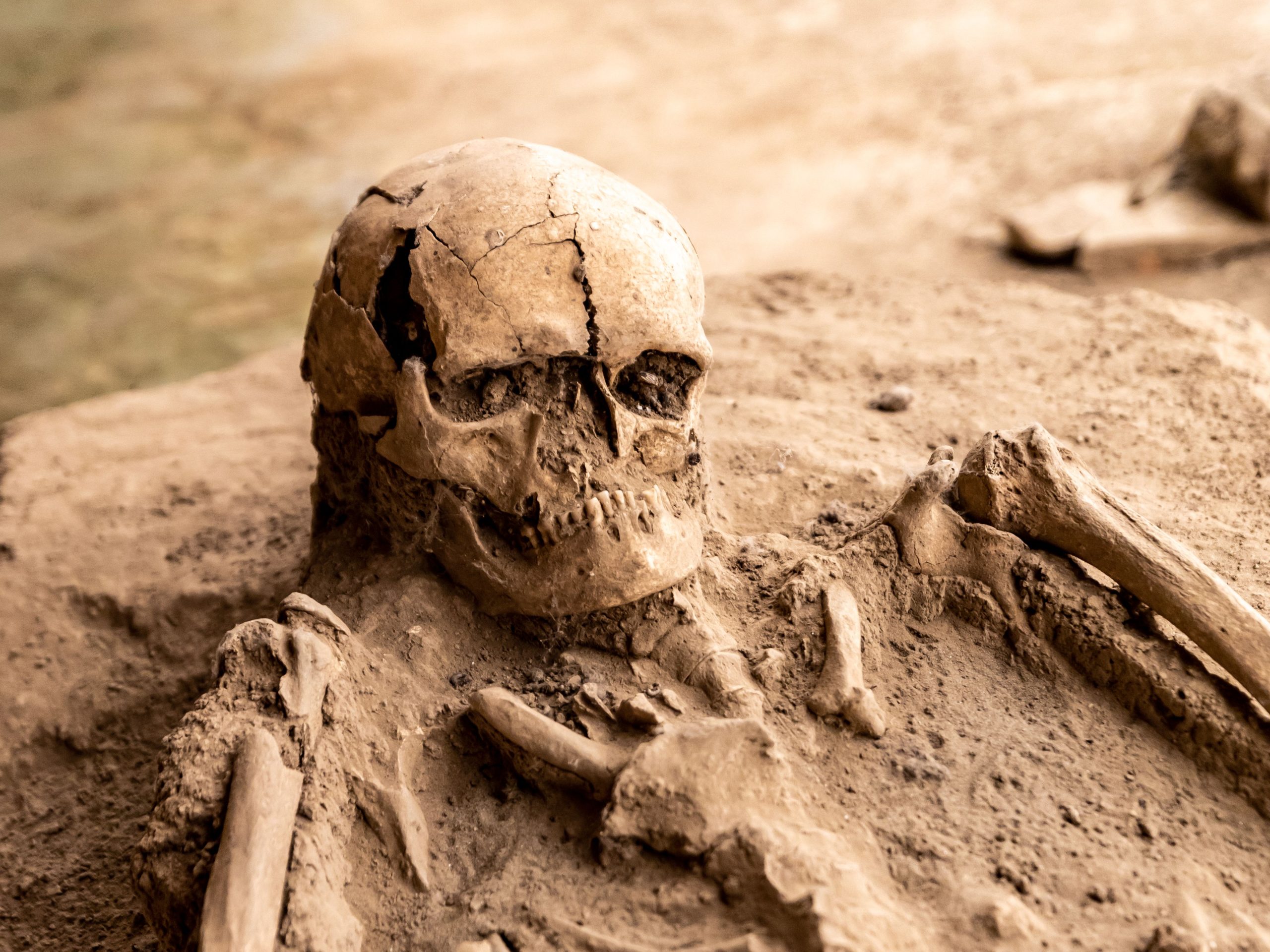
Roughly 109 billion people have died on this planet. You’d think we’d be tripping over them. Instead, their bones have dissolved, scattered, burned, or been quietly waiting under some of the busiest places on Earth.
Somewhere around 117 billion members of our species have been born, according to the best-known attempt to count them, by the Population Reference Bureau. About 8 billion of them are alive right now, which leaves roughly 109 billion people who have lived, died and gone somewhere. PRB is candid that the figure is part science and part art: there are no demographic records at all for more than 99% of human existence, so the total rests on assumptions about ancient population sizes and birth rates. Even so, the order of magnitude is not in dispute. Humanity has produced an almost unimaginable number of corpses.
Now try some napkin math. Spread 109 billion people evenly across Earth’s roughly 149 million square kilometers of land and you get about 730 per square kilometer, or something like four per American football field. Every field, forest and desert, everywhere. Yet you can dig a vegetable garden, walk a trail or excavate a basement and come up with rocks, roots and the occasional bottle cap, not a femur. So where did they all go?
The ground eats bones
The first answer is that bones aren’t nearly as permanent as Halloween decorations suggest. A skeleton is mostly a calcium phosphate mineral called hydroxyapatite, and that mineral has a natural enemy: acid. Archaeological guidance notes that soil with a pH of 5 or lower is likely to break down the mineral in bone, while neutral or alkaline soil helps preserve it. Excavators put it more bluntly: acid sands and gravels attack bones, while chalk tends to protect them.
The most famous demonstration is a burial with nobody in it. Around AD 625, the Anglo-Saxons at Sutton Hoo in eastern England dragged a ship more than 80 feet long up from the river, filled its central chamber with gold, silver and weapons, and buried it under a mound for someone extraordinarily important. When archaeologists opened it in 1939, the treasure was there. The ship’s timbers were gone, surviving only as stains and rows of rivets in the sand. And the person it was all for had vanished entirely. Of the owner, the Current Archaeology account observes, there was no trace, and the explanation most often given is that the acidic soil consumed flesh and bone alike. Nearby sites in similar ground tell the same story: some graves contain no bones at all, only ghostly body-shaped stains.
So one reason we don’t trip over our ancestors is that, across huge swaths of the planet, the soil quietly dissolved them. Bones can last for many thousands of years in a dry cave or chalky ground and disappear far faster in acidic sand, which is why no one can honestly tell you how long a skeleton “lasts.” It depends almost entirely on where it lies.
Most of our ancestors were never buried at all
The second answer is older and stranger. For most of our species’ history, there is little evidence that we buried anyone.
The oldest known burial in Africa, the continent where Homo sapiens evolved, belongs to a child of about three, laid in a pit at the mouth of the Panga ya Saidi cave in Kenya around 78,000 years ago, apparently wrapped in a shroud with the head resting on something soft. Researchers nicknamed the child Mtoto, Swahili for “child.” It’s a moving discovery, and also a revealing one, because the Nature paper describing it notes that burials from that period are exceedingly rare in Africa. Across Europe and the Middle East, researchers have found only about 30 burials of Neanderthals or Homo sapiens dating from 40,000 to 120,000 years ago.
Our species is roughly 300,000 years old. For a long stretch of that time, most people who died were likely left on the surface, where the dead return to the landscape fast. A biology textbook’s description of a dead antelope on an African plain captures what probably happened to most of our ancestors: scavengers take the body, insects and bacteria take the rest, and the scattered bones break down until they return to the soil.
That’s also why ancient humans are so rare even though dinosaurs seem to be everywhere in museums. Fossilization is a geological accident requiring rapid burial and mineral-rich water, and a fossil collection is the survivors of tens of millions of years of improbable luck. The oldest known Homo sapiens fossils, from Jebel Irhoud in Morocco, are around 300,000 years old, and they aren’t a tidy skeleton. They’re fragments of skulls, jaws and teeth from several individuals, painstakingly reconstructed. Older human relatives such as Lucy belong to entirely different species and are fossils, which is a different thing from the ordinary bones in a churchyard.
Then we started keeping them
Here’s where the question turns around. Once people settled down and began burying their dead in earnest, they didn’t scatter them across the landscape. They put them in very specific places, close to home, in staggering numbers. And then, over the centuries, they forgot where those places were.
In 1991, construction crews digging the foundation of a federal office building in Lower Manhattan hit human remains about 30 feet down. They had found New York’s African Burial Ground, where the National Park Service estimates 15,000 to 20,000 enslaved and free Africans were buried between the 1690s and 1794. Over two years, archaeologists excavated about an acre of the original 6.6-acre cemetery and removed 419 individuals. The rest are still there, beneath the streets around 290 Broadway. A few blocks north, historians estimate that some 20,000 people lie beneath Washington Square Park, which served as the city’s potter’s field for the poor and yellow-fever victims from 1797 to the 1820s.
London is the champion. When the Crossrail project dug a new entrance at Liverpool Street station, Museum of London Archaeology excavated around 3,500 skeletons from the old Bedlam burial ground, a cemetery thought to hold more than 30,000 Londoners buried between 1569 and 1738. A few miles west, HS2 rail engineers had to exhume a former burial ground behind Euston station holding at least 40,000 people. In January 2019, they found Captain Matthew Flinders, the navigator who led the first circumnavigation of Australia and helped give the country its name. His headstone had been removed when the station expanded in the 1840s, leaving a long-running belief that he lay under Platform 15. He was identified by the lead plate on his coffin, which hadn’t corroded.
Paris solved its overflow problem by moving the dead in bulk. By the late 18th century its cemeteries were so overfull that, beginning in 1786, covered wagons carried bones by night into old limestone quarries beneath the city. Today the Catacombs hold the remains of more than six million people, stacked in walls under a city of two million living residents.
That’s the real shape of the answer. The dead aren’t spread evenly at four per football field. Over most of the planet there may be almost none left, and in the places where people lived for centuries, they’re concentrated beyond belief, often directly beneath where people still live.
So could you dig one up in your backyard?
There’s no honest universal probability, and anyone who gives you one is guessing. It depends on what your soil does to bone, and above all on your land’s history. Random ground in most places is unlikely to turn up a recognizable skeleton. Ground that was once a churchyard, a family plot, a hospital, a battlefield or a village site is a different story, as construction crews in old cities keep discovering.
If you do find something that looks human, the rules are surprisingly uniform: stop. In Florida, for example, state guidance tells finders to halt all activity and notify law enforcement or the medical examiner, notes that disturbing human remains is illegal even on private property, and gives the State Archaeologist authority over remains of people dead at least 75 years. Investigators first decide whether they’re looking at a crime scene or history; only then do the archaeologists, and often descendant communities, take over.
Meanwhile, the future will leave even fewer bones. The National Funeral Directors Association projects that 63.4% of Americans who died in 2025 were cremated, more than double the burial rate, and expects that to reach 82.3% by 2045. Archaeologists a thousand years from now may find our century surprisingly hard to dig up.
So the reason we don’t find skeletons everywhere isn’t that the dead disappeared. Many did, dissolved into acidic soil or scattered across ancient plains. But a remarkable number simply stayed close to the living, and the living built on top of them. The bones aren’t under the empty field. They’re under the train platform, the office tower and the park where people eat lunch on a sunny afternoon, which makes the busiest ground in any old city some of the most crowded ground on Earth.